
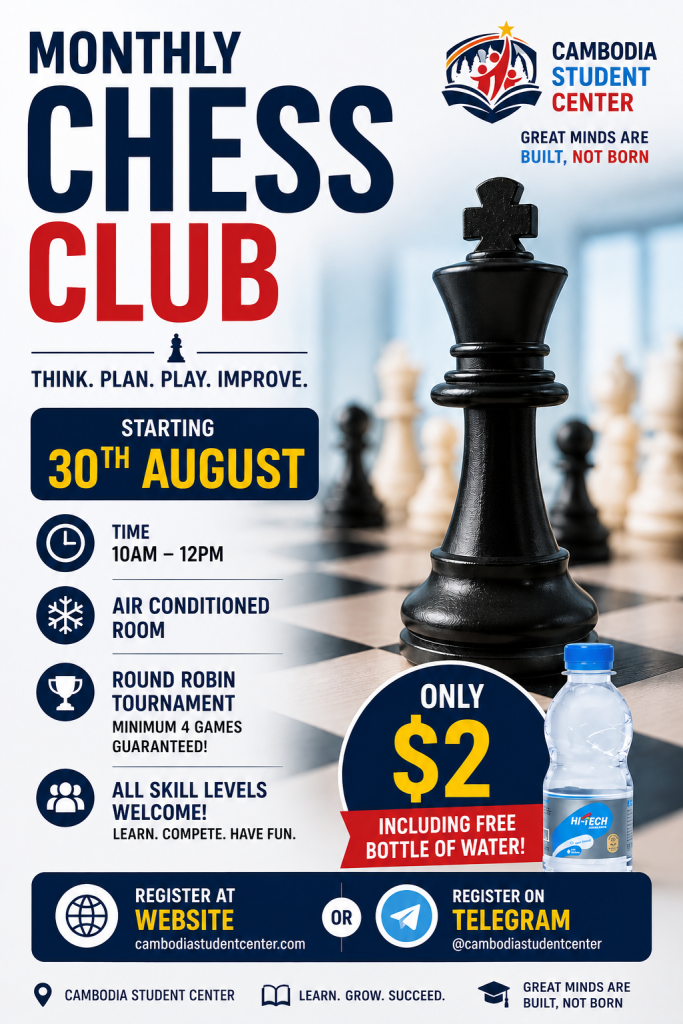
Monthly Chess Competition
Date: Sunday 30th August 2026
Time:
10am to 12pm
Round robin tournament
Minimum 4 games per player
Location:
Cambodia Student Center
Phnom Penh, Cambodia
Entry Fee:
$2 per player – includes free bottle of water
Chess is more than just a game. It develops logical thinking, patience, concentration, memory, strategic planning, and problem-solving skills that can support success in school and everyday life.
At Cambodia Student Center, our Chess classes help students strengthen their thinking skills while learning in a fun, engaging, and supportive environment. Students learn to think ahead, make decisions, solve challenges, and build confidence one move at a time.
Why Chess and the Rubik’s Cube Are Important for Cambodian Students
Learning chess and the Rubik’s Cube helps students think differently.
Rather than memorising information, students learn how to analyse situations, make decisions, recognise patterns, and solve problems logically.
For Cambodian students, these activities can help:
- Improve concentration and focus
- Develop logical and critical thinking
- Strengthen memory
- Improve patience and perseverance
- Build confidence when solving problems
- Develop planning and decision-making skills
- Improve observation and pattern recognition
- Encourage creative thinking
These skills support learning across mathematics, science, coding, and many other school subjects.ifelong learning. participate in a more connected world.
How Chess Skills Are Best Learnt
Students improve at chess through regular practice, guided learning, and playing increasingly challenging games.
Success comes from understanding chess principles, recognising patterns, and learning how to make strong decisions rather than simply memorising moves.
Learn One Step at a Time
Every great chess player started with the basics.
Students first develop a strong understanding of the chessboard, pieces, rules, and fundamental principles before gradually progressing to more advanced strategies.
Small improvements made consistently lead to long-term success.
Solve Problems Through Practice
Every chess position presents a new challenge.
Students learn how to:
- Analyse positions
- Think ahead
- Identify threats
- Consider different moves
- Find solutions
- Learn from mistakes
- Adapt their strategy
With regular practice, problem-solving becomes faster and more natural.
Build Memory and Pattern Recognition
Chess relies heavily on recognising patterns and remembering important principles.
Students gradually develop their understanding of:
- Opening principles
- Tactical combinations
- Common checkmate patterns
- Positional ideas
- Endgame principles
- Strategic concepts
- Opponent threats
Pattern recognition becomes stronger through repetition, playing games, and analysing positions.
Learn Through Friendly Competition
Playing against other students provides an important part of chess development while keeping learning enjoyable.
Friendly matches encourage:
- Sportsmanship
- Respect
- Confidence
- Decision-making
- Emotional control
- Patience
- Continuous improvement
Competition becomes an opportunity to learn, improve, and challenge yourself rather than simply focusing on winning.
A Supportive Approach to Chess Tutoring
Every student develops at their own pace.
Some students may be completely new to chess, while others may already have experience playing at school, at home, or in competitions.
At Cambodia Student Center, lessons are designed to suit each student’s age, experience, and ability.
Our teaching approach focuses on:
- Logical thinking
- Strategic planning
- Problem-solving
- Concentration
- Patience
- Memory development
- Decision-making
- Confidence building
- Positive encouragement
- Enjoyment of learning
Students are encouraged to think independently, ask questions, and learn from every game and challenge.
Chess Support for Every Student Level
Beginner
Students begin by learning the fundamentals of chess.
Lessons may include:
- Chessboard setup
- Piece movement
- Capturing pieces
- Check and checkmate
- Castling
- Basic chess rules
- Simple tactics
- Basic checkmate patterns
- Introduction to opening principles
The goal is to make chess enjoyable while building a strong foundation and confidence.
Intermediate
Students develop stronger strategic and tactical thinking.
Lessons may include:
- Opening principles
- Tactical combinations
- Forks, pins, and skewers
- Attacking and defending
- Positional play
- Pawn structures
- Endgame fundamentals
- Game analysis
- Tournament preparation
Students learn to evaluate positions more effectively and make stronger decisions during games.
Advanced
Advanced students refine their strategic understanding and competitive skills.
Lessons may include:
- Advanced chess strategy
- Opening preparation
- Complex tactical positions
- Positional analysis
- Advanced endgame concepts
- Tournament preparation
- Game review and analysis
- Calculation techniques
- Performance improvement
Students continue developing their ability to think several moves ahead and respond effectively to different playing styles.
Chess Tutoring for School Students in Phnom Penh
Many students enjoy playing chess but may not know how to improve their skills.
Chess tutoring provides structured guidance while keeping learning enjoyable and engaging.
Lessons may include:
- Chess strategy
- Tactical puzzles
- Opening principles
- Endgame practice
- Game analysis
- Logic challenges
- Critical thinking
- Tournament preparation
- Friendly matches
Students build valuable thinking skills while developing their understanding and enjoyment of the game.
Building Confidence Through Strategic Thinking
Not every game will be won, and not every decision will be correct.
Students learn that mistakes are an important part of becoming a better chess player.
Each game provides an opportunity to understand what happened, identify mistakes, and make better decisions next time.
As students improve, they develop greater confidence, patience, resilience, and independence when facing difficult challenges.
Chess and Future Opportunities
The strategic thinking developed through chess can support students across many areas of education and future careers.
Chess encourages skills such as:
- Logical reasoning
- Planning
- Critical thinking
- Problem-solving
- Concentration
- Decision-making
- Pattern recognition
- Patience
- Strategic analysis
These skills can be valuable in areas such as:
- Mathematics
- Science
- Engineering
- Coding and Technology
- Artificial Intelligence
- Business
- Finance
- Research
- Architecture
- Data Analysis
More importantly, chess encourages curiosity, independent thinking, and a willingness to keep learning.
Frequently Asked Questions
Who can join Chess classes?
Classes are suitable for primary, secondary, and high school students. Beginners are welcome, and no previous chess experience is required.
Do students need to know how to play chess?
No. Students can begin with the fundamentals and gradually progress as their skills and confidence develop.
Can chess help with school learning?
Chess can help develop concentration, logical thinking, memory, planning, problem-solving, and decision-making skills that can support learning across many school subjects.
Is private chess tutoring available in Phnom Penh?
Cambodia Student Center offers individual and small-group Chess tutoring depending on student needs and class availability.
Can students participate in chess competitions?
Students who are interested may be encouraged to participate in friendly competitions and tournaments as their skills and confidence develop.
How often should students practise chess?
Short, regular practice sessions several times each week can help students build their skills more consistently than occasional practice.
Think Ahead. Make Better Moves.
Chess teaches students to think ahead, analyse challenges, make decisions, and learn from their mistakes.
At Cambodia Student Center, we believe every student can develop stronger thinking skills through chess—one game, one challenge, and one move at a time.